Making a category page GEO & SEO friendly
Most page template work ships as a slide describing what should change. We rebuilt the page instead. It is open below, with a control that applies each change in place.
01See it yourself
Open the rebuilt page
This is the working rebuild, not a screenshot. The control at the bottom right moves the page between two states, so you can watch every structural change applied in place and then read the reasoning behind each one.
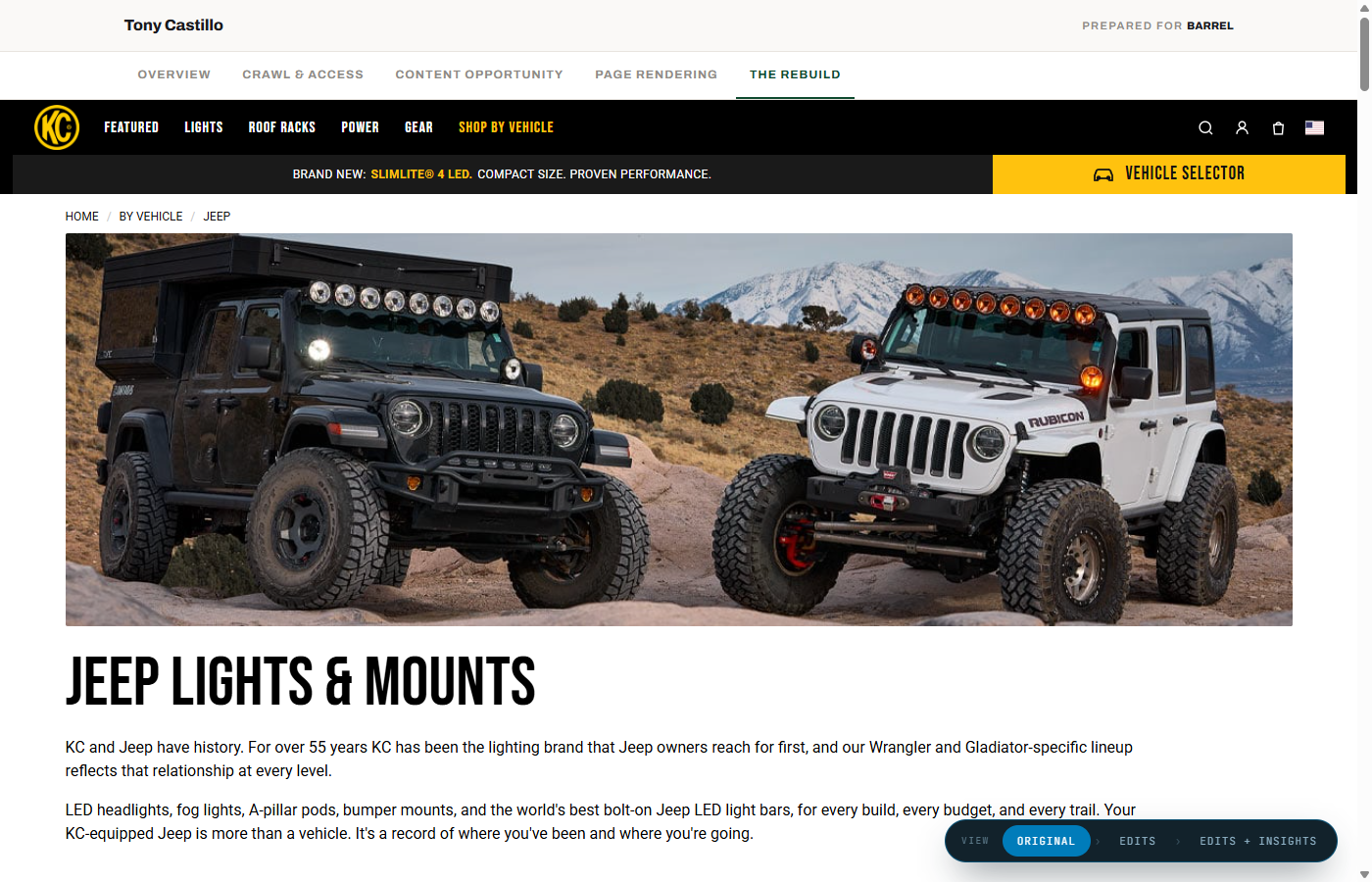 Open the rebuilt page →
The artifact keeps the client's branding, since it is a rebuild of their real page.
Original
The category page as it shipped. The baseline for everything that follows.
Edits and insights
Every structural change applied in place, tagged new or enhanced, with the reasoning pinned beside each one.
02What changed, and what did not
Products, merchandising and commercial intent unchanged. Only the structure moved.
The page as it shipped
- A product grid, and little else a model could read as an answer.
- Fitment information living inside product variants, not on the page.
- Differentiators expressed as brand adjectives rather than specifications.
- No question-and-answer content, so nothing in a quotable shape.
- Outbound links to products only, leaving the page a dead end in the link graph.
The page rebuilt
- Fitment tables by model and year, on the page, in parseable markup.
- A plain what makes this different block, written as comparable specifications.
- Real FAQs drawn from support tickets and review questions, in proper Q&A structure.
- Build guides and video sections that give the page reasons to link outward.
- Customer stories and reviews kept as text rather than locked in a widget.
03An idea board for the whole catalog
We built one page so the client could see how to adapt any category page. Each move is applied in context, so their team can judge it on a real page instead of reading a description.
A menu to pick from. Specification tables, a comparison block, real Q&A, outbound links. Few categories need all four. On a working page a team can see which of them belong on theirs.